
A galaxy is a gravitationally bound collection of stars, gas, dust and dark matter, ranging from dwarf galaxies with a few million stars to giants containing trillions. The observable universe holds an estimated two trillion galaxies, each one an island of stars separated from its neighbours by vast stretches of empty space.
Spiral galaxies
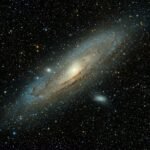
Spirals, like our own Milky Way, are perhaps the most beautiful. They feature a flat, rotating disc with curving arms that wrap around a bright central bulge. These arms are regions where gas is compressed and new stars form, which is why spirals tend to glow with young, blue stars. Many spirals, including ours, also have a central bar of stars.
Elliptical galaxies
Elliptical galaxies are smooth, rounded collections of stars with little structure and almost no ongoing star formation. They are dominated by older, redder stars and contain very little of the cool gas needed to make new ones. The largest galaxies in the universe are giant ellipticals, often found at the centres of galaxy clusters.
Irregular and dwarf galaxies
Not every galaxy fits neatly into a category. Irregular galaxies lack any clear shape, often distorted by gravitational encounters with their neighbours. Dwarf galaxies, the most common type of all, are small and faint, and many orbit larger galaxies like satellites.
Galaxies that grow by merging
Galaxies are not fixed for all time. They collide and merge over billions of years, and astronomers believe that many large ellipticals formed when two spirals crashed together. By studying galaxies at different distances, and therefore at different ages, we can trace how these cosmic structures have evolved since the early universe.