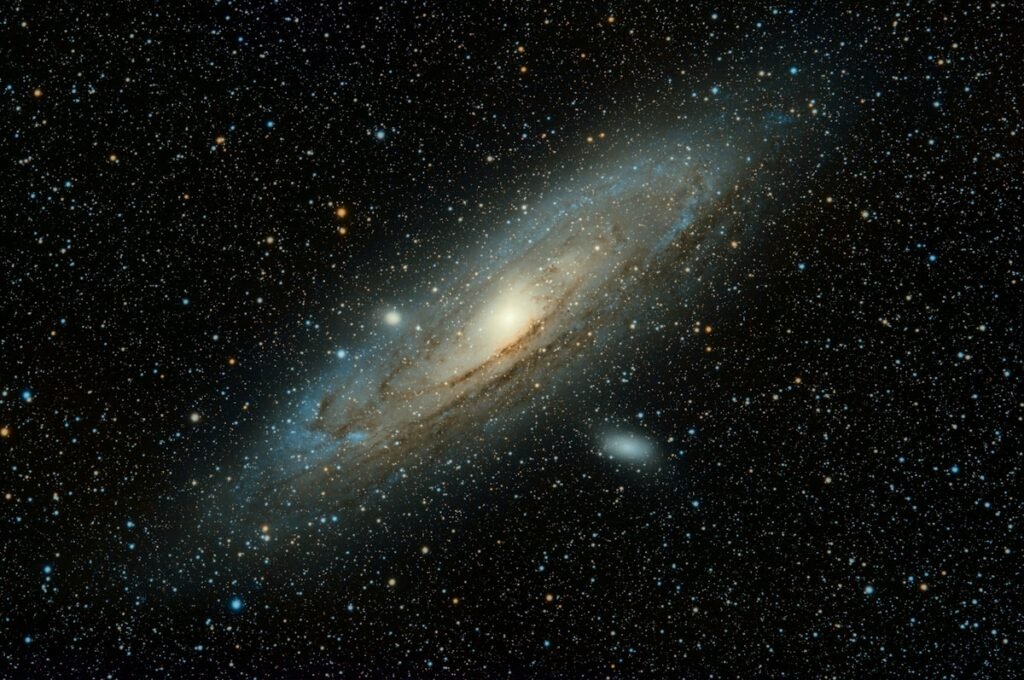

Stars may look eternal, but they are born, live out long lives and eventually die, just on timescales far longer than human history. The story of a star is really the story of a long battle between gravity, which tries to crush it, and the energy from nuclear fusion, which pushes back. How that battle ends depends almost entirely on one thing: the star’s mass.
Born in a cloud of gas
Stars begin life inside vast clouds of gas and dust called nebulae. When part of a cloud becomes dense enough, gravity pulls the material together into a tight, spinning core. As the core heats up, pressure and temperature eventually become high enough to ignite nuclear fusion, fusing hydrogen into helium. At that moment, a new star is born.
A long, stable adulthood
For most of its life, a star sits in a stable phase called the main sequence, steadily fusing hydrogen in its core. Our Sun is about halfway through this phase, which for it lasts around ten billion years. Smaller, cooler stars can burn for tens of billions of years, while massive, hot stars race through their fuel in just a few million.
The dramatic end
When a star exhausts its hydrogen, it swells into a red giant. What happens next depends on mass. A Sun-like star gently sheds its outer layers, leaving behind a hot, dense white dwarf. Massive stars meet a far more violent end, collapsing and then exploding as a supernova, briefly outshining an entire galaxy.
Seeds of new stars
Stellar death is not the end of the story. The elements forged inside stars, including the carbon, oxygen and iron that make up our bodies and our planet, are scattered back into space by these explosions. There they enrich new nebulae, seeding the next generation of stars. In a very real sense, we are made of stardust.