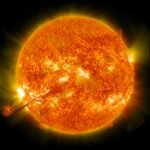

The Sun is the single most important object in our cosmic neighbourhood. It holds about 99.8 percent of all the mass in the Solar System, and its gravity keeps the planets, asteroids and comets locked in their orbits. Without it, Earth would be a frozen, lifeless rock drifting in the dark.
A giant ball of plasma
The Sun is a star roughly 4.6 billion years old, sitting about 150 million kilometres from Earth. It is not solid or liquid but a vast sphere of plasma, made up of around 73 percent hydrogen and 25 percent helium, with traces of heavier elements. Its visible surface, the photosphere, glows at roughly 5,500 degrees Celsius, while the core reaches an astonishing 15 million degrees.
How the Sun makes its energy
Deep in the core, crushing pressure and temperature force hydrogen nuclei to fuse into helium in a process called nuclear fusion. Each second, the Sun converts around 600 million tonnes of hydrogen into helium, releasing energy that slowly works its way outward over tens of thousands of years before finally escaping as sunlight. That light then takes just over eight minutes to reach Earth.
Sunspots, flares and the solar cycle
The Sun is far from calm. Its surface is marked by sunspots, cooler regions tied to intense magnetic activity, and it regularly unleashes solar flares and coronal mass ejections that fling charged particles across the Solar System. These follow a roughly 11-year cycle of rising and falling activity. When that material strikes Earth’s magnetic field, it can spark beautiful auroras, but strong storms can also disrupt satellites and power grids.
The Sun’s future
The Sun is currently middle-aged. In about five billion years it will exhaust the hydrogen in its core, swell into a red giant large enough to engulf the inner planets, and eventually shed its outer layers to leave behind a dense, cooling ember called a white dwarf. For now, though, it remains a remarkably stable engine, and understanding it helps us protect the technology our modern world depends on.