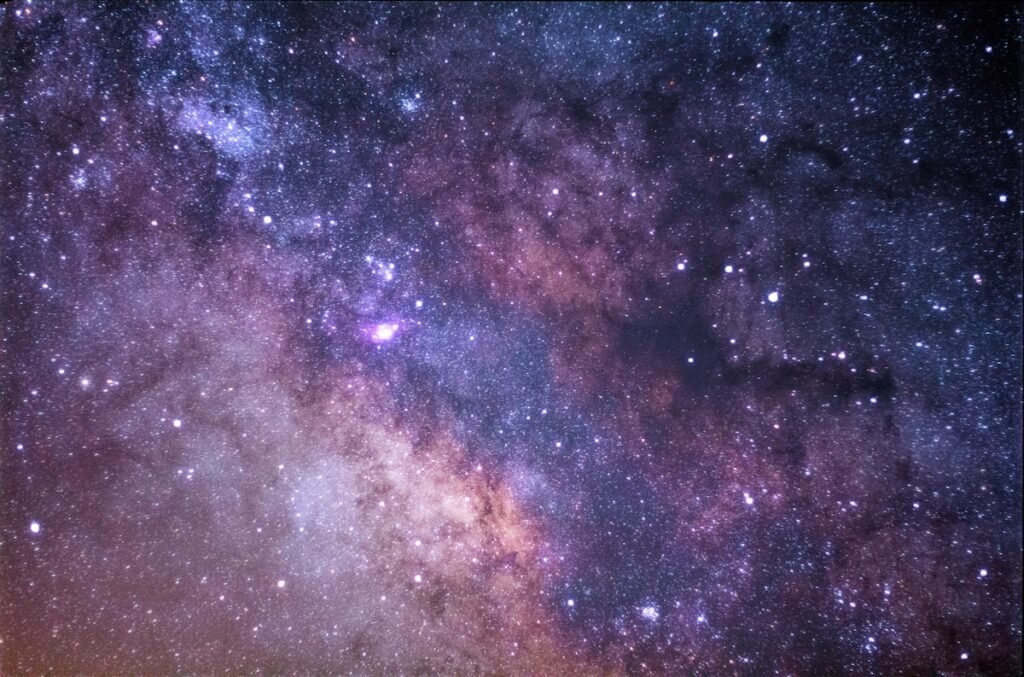

It is one of the most humbling facts in all of science: everything we can see, every star, planet, galaxy and cloud of gas, accounts for only about five percent of the universe. The remaining 95 percent is made of two mysterious ingredients we cannot directly observe, known as dark matter and dark energy.
The matter we can see
Ordinary matter, the kind that makes up atoms, is called baryonic matter. It forms the stars, planets and everything on Earth, including us. Yet when astronomers weigh galaxies by measuring how fast they spin, they find far more gravity at work than visible matter alone could explain.
Dark matter: the invisible scaffolding
That missing gravity points to dark matter, an invisible substance that makes up roughly 27 percent of the universe. It does not emit, absorb or reflect light, so we detect it only through its gravitational pull. Dark matter forms a vast web that shapes how galaxies cluster together and stops them from flying apart. Despite decades of searching, we still do not know what it is made of.
Dark energy: the great accelerator
Even stranger is dark energy, which accounts for about 68 percent of the cosmos. In the 1990s, astronomers discovered that the expansion of the universe is not slowing down, as expected, but speeding up. Dark energy is the name given to whatever is driving that acceleration, pushing galaxies apart ever faster.
A cosmic mystery
Together, dark matter and dark energy represent the biggest unsolved puzzle in physics. Solving it could reshape our understanding of gravity, space and time themselves. For now, we are left with a remarkable realisation: the universe we can see is only a thin sliver of the whole.