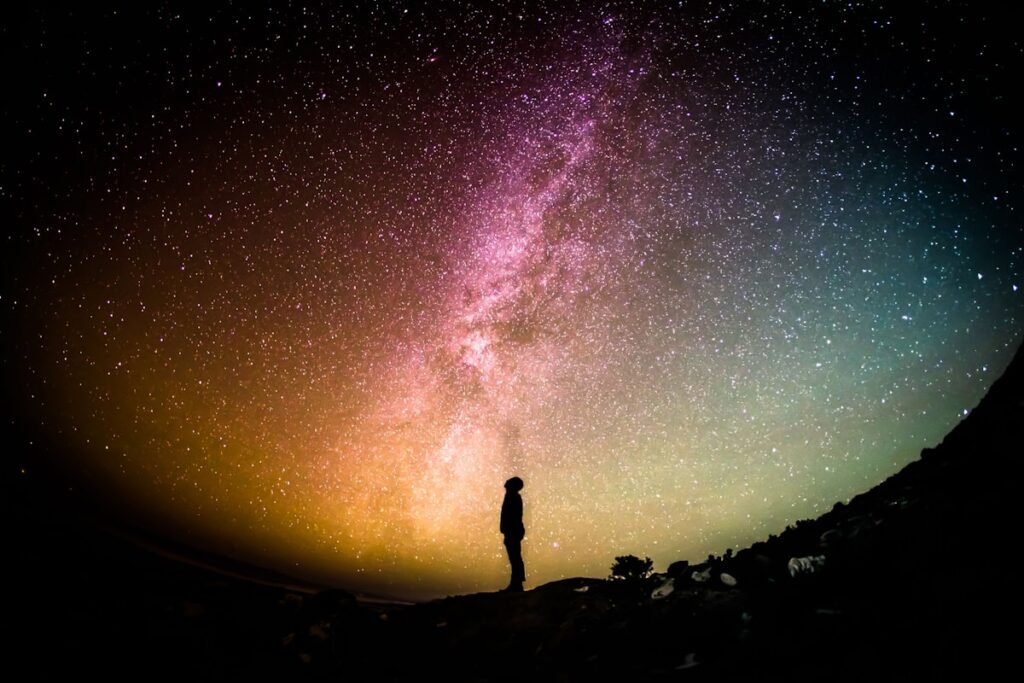

On a clear, dark night, far from city lights, you can see a faint band of light stretching across the sky. That glow is the combined light of billions of distant stars, and it is the inside view of our own galaxy, the Milky Way. Everything you have ever seen with the naked eye belongs to it.
A barred spiral
The Milky Way is a barred spiral galaxy, a flattened disc of stars, gas and dust with graceful arms winding outward from a bright central bar. It measures roughly 100,000 light years across and contains somewhere between 100 and 400 billion stars, along with enormous clouds of gas where new stars are still being born.
Our place within it
Our Solar System sits about 27,000 light years from the centre, in a minor arm called the Orion Arm. We are not at the heart of the galaxy, nor at its edge, but roughly two thirds of the way out. The entire Solar System orbits the galactic centre at around 800,000 kilometres per hour, yet a single lap still takes about 230 million years.
The monster at the centre
At the very heart of the Milky Way lies Sagittarius A*, a supermassive black hole with a mass of around four million Suns. Far from swallowing the galaxy, it acts as a gravitational anchor around which the inner stars whirl. Astronomers have even captured an image of the glowing gas surrounding it.
A galaxy with a future
The Milky Way is not alone. It is on a slow collision course with the neighbouring Andromeda Galaxy, and in roughly four billion years the two will merge into a single, larger galaxy. Despite the dramatic name, stars are so far apart that almost none will actually collide. Instead, the night sky of the distant future will be transformed into something entirely new.